
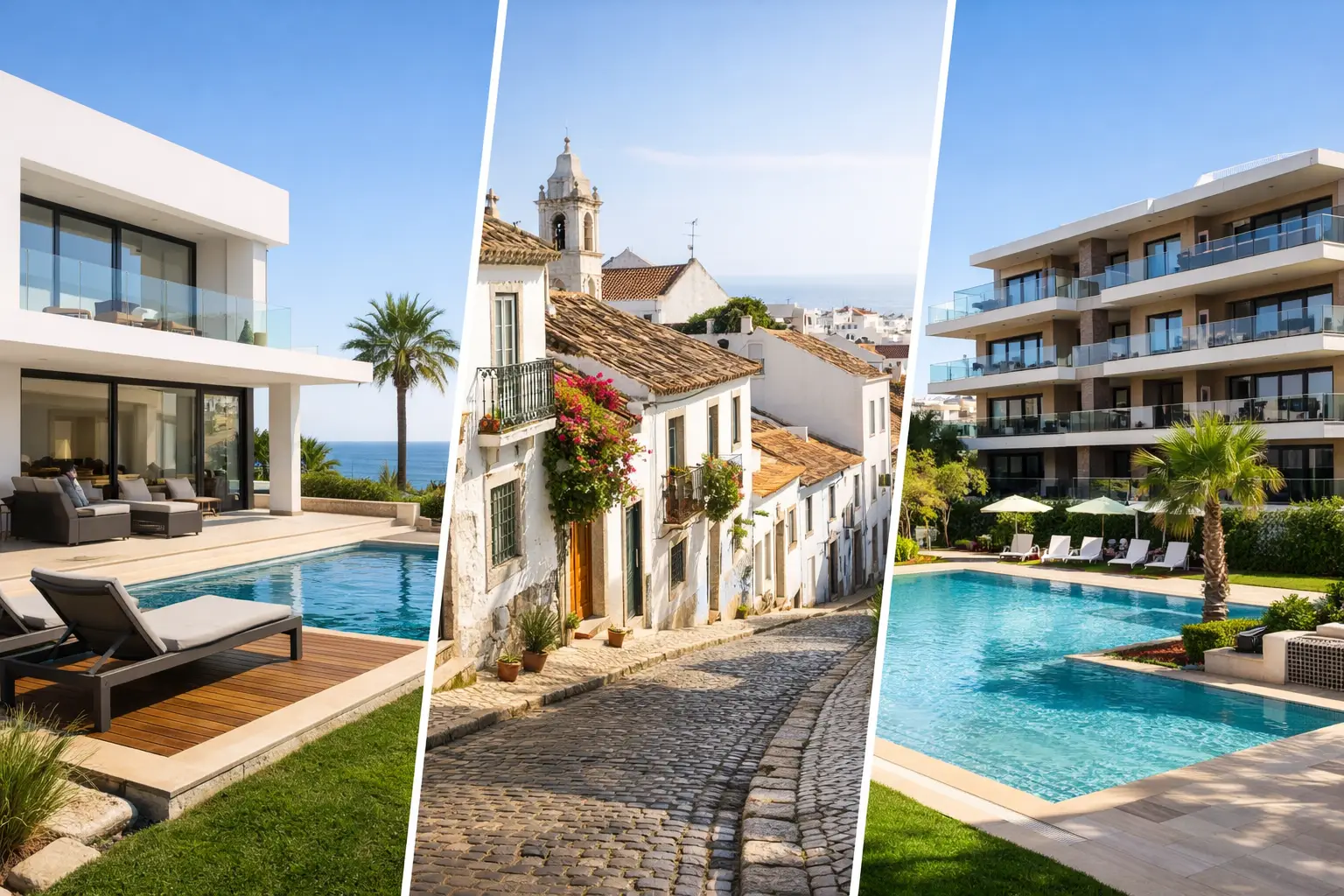
Algarve Town Comparison for Property Buyers

A beautiful pool, a sea view and a five-minute walk to the beach can all be true. They can also tell you almost nothing about whether the surrounding place will work in November, on a school morning, or when family arrives with a hire car. That is the point of an Algarve town comparison: not to crown one town ‘best’, but to identify the daily compromises attached to each choice before a property search becomes expensive and emotionally loaded.
The Algarve is compact on a map but highly varied on the ground. A drive that looks simple can involve slow coastal roads, summer congestion, limited parking or a steep final approach to a hillside home. A town that feels lively in August may feel too quiet in winter. Another that appears less polished may offer the practical life many full-time residents actually need.
Start with the life you are buying
Before comparing towns, be clear about the job the property needs to do. A couple seeking a lock-up-and-leave holiday base has different tolerances from a family relocating full time. An investor may value guest convenience and broad seasonal appeal, while a retiree may place pharmacies, level walking routes and reliable year-round services above proximity to the busiest beach.
Write down what is non-negotiable, then separate it from what is merely attractive. For example, ‘walkable to restaurants’ is not the same as ‘quiet enough to sleep with windows open’. ‘Near the beach’ may mean a flat five-minute walk, a difficult hill, or a short drive followed by a search for parking. The distinction matters more than a town name.
Algarve town comparison: the main buyer profiles
Lagos: character, beaches and a more international feel
Lagos is often a strong fit for buyers who want a recognisable town rather than a resort complex. It combines a historic centre, marina, beaches, restaurants and a sizeable international population. There is more life outside high summer than in many purely holiday-led locations, and the western position appeals to people who enjoy an active, outdoors-focused lifestyle.
The trade-off is that popularity creates pressure. Central streets can be noisy, parking can be awkward, and not every property described as ‘Lagos’ provides easy access to the old town or beach. Some residential areas are practical but less atmospheric; some character addresses are charming but demand a realistic view of vehicle access, loading, humidity and late-night footfall.
Lagos suits buyers who want movement and choice around them. It may be less suitable for someone seeking a very quiet, highly polished or central-Algarve base.
Portimão and Praia da Rocha: convenience with sharper contrasts
Portimão is a working city with practical infrastructure, larger supermarkets, services and year-round activity. It can make sense for buyers who value everyday convenience over postcard appeal. Praia da Rocha, close by, offers dramatic beach access and a high concentration of holiday accommodation, restaurants and seasonal entertainment.
These are two quite different environments, despite their proximity. Portimão can feel functional and local, while Praia da Rocha can feel intensely seasonal and busy. Building quality, parking arrangements, street noise and the view from a balcony deserve close attention here. A flat with a good internal finish may still face a busy road, a large car park or a summer nightlife route.
For a buyer who wants amenities and does not need an old-town setting, Portimão can offer a grounded alternative. For a second-home buyer focused on beach access, Praia da Rocha can work well, provided the building and immediate block are right.
Carvoeiro: easy holiday appeal, limited local scale
Carvoeiro has a compact, attractive centre and a strong holiday-home market. Its cliffs, coves and restaurant scene create immediate appeal, particularly for buyers who want a well-known coastal base without the scale of Albufeira. Villas and low-rise developments around the town can offer privacy and outdoor space.
The practical question is how much you need from the town in the quieter months. Carvoeiro remains lived in, but its small scale is noticeable. Many homes are on hilly roads, pavements can be inconsistent, and driving is often part of daily life. A property that is technically near the centre may still be uncomfortable to reach on foot in heat or after dark.
Carvoeiro is often best for buyers who accept a car-led routine in return for a relaxed coastal setting. It is less convincing for anyone who needs frequent, flat, spontaneous access to a broad range of services.
Loulé: year-round substance away from the coast
Loulé is a useful corrective to the assumption that the right Algarve property must be by the sea. It has a genuine town centre, market, schools, services and a more established year-round rhythm than many coastal resorts. Buyers often choose it for a sense of local life, practical access and a more central position for reaching different parts of the region.
You give up immediate beach access and, in some locations, the ocean view that commands a premium elsewhere. The surrounding countryside is varied, so road quality, drainage, mobile signal and the reality of a rural address should be assessed carefully. ‘Ten minutes from Loulé’ can mean very different things depending on the road and the final kilometre.
Loulé can suit full-time households who want a town that functions beyond the holiday calendar. It can also work for buyers who prefer to visit the coast rather than live inside its busiest zones.
Vilamoura and Quarteira: planned comfort versus lived-in convenience
Vilamoura offers a planned environment built around the marina, golf, beaches and managed developments. Buyers who prioritise order, leisure infrastructure and easy guest appeal often find it straightforward to understand. It is a practical choice for a second home where simplicity matters.
The limitation is that different parts of Vilamoura have very different atmospheres. A quiet villa area, a marina-facing flat and a development beside a golf course do not provide the same experience. Some places can feel notably quieter outside the main season, while others carry road noise or maintenance activity that is absent from listing photography.
Quarteira, immediately alongside, is more direct and more lived-in. It has a long promenade, everyday shops and a less curated feel. It may lack Vilamoura’s polish, but some buyers prefer its straightforward daily convenience and broader year-round rhythm.
Albufeira: strong demand, careful street selection
Albufeira has broad name recognition, beaches and sustained visitor demand. That can be attractive to buyers who want an energetic setting and a property with obvious holiday appeal. It also has many distinct areas, from old-town streets to newer residential zones and quieter outskirts.
But this is where broad labels become particularly unhelpful. The difference between a peaceful residential road and a late-night entertainment corridor can be a few minutes apart. Hills, pedestrian routes, parking restrictions and summer traffic are all material. A property can be close to the action without being well placed for the life you want.
Albufeira may suit buyers comfortable with a busier resort environment. It requires disciplined micro-area selection, especially if sleep, privacy or regular car use matter.
Tavira and Olhão: eastern Algarve, different pace
Tavira attracts buyers looking for traditional architecture, a gentler pace and a town with enduring local character. It is visually appealing and comparatively calm, but its island beaches require more planning than simply walking down to the sand. The eastern Algarve also feels geographically separate from the central and western resort belt, which is either a benefit or a constraint depending on your routine.
Olhão is more working-town than polished resort. It offers a strong local identity, waterfront markets and access towards the Ria Formosa islands. It can be compelling for buyers who value authenticity and services over a manicured holiday atmosphere. It is not for everyone: the visual character is more mixed, and proximity to the waterfront does not automatically mean a quiet or private setting.
Both towns deserve consideration from buyers who want less resort intensity. They are not interchangeable, and neither should be chosen solely from photographs of tiled facades or boats in the harbour.
Compare the street, not just the town
Once you have a short list, stop asking only, ‘Which town is right?’ Ask what happens on the specific street. Can two cars pass? Where do visitors park? Is the terrace overlooked in winter when neighbouring homes are occupied? Does the route to shops involve a blind bend or a steep pavement? What is behind the property boundary, and what could change?
This is where overseas buyers can lose time. Property portals are good at showing rooms, pools and views. They are weak at showing delivery access, bin locations, neighbouring holiday lets, road noise, winter shade and whether an apparently peaceful setting is peaceful only at noon on a weekday.
The right Algarve town is rarely the one with the strongest first impression. It is the one whose ordinary Tuesday suits your actual life. Begin with the town, then test the micro-area, then examine the property in its full surroundings. That order gives you a far better chance of buying a place you will still enjoy after the first summer has passed.