
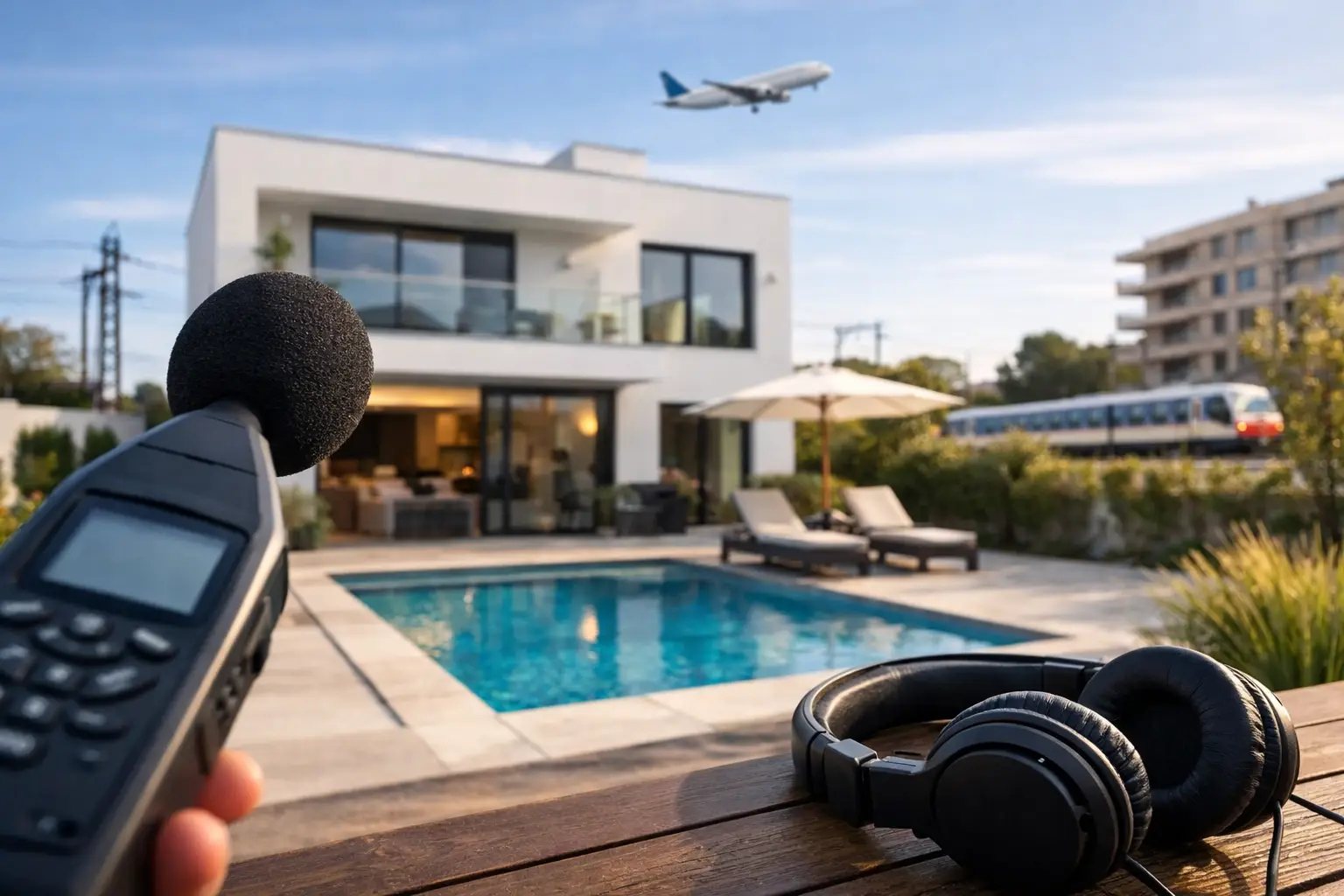
How to Check Property Noise Before Buying

A sunny terrace, open shutters and a wide-angle listing photo can make almost any setting look peaceful. But if you want to check property noise before buying, the question is not whether a home feels quiet for 20 minutes on a viewing. It is whether its sound environment works at 7am on a school morning, at midnight in August, and during the months when you will actually use it.
Noise is one of the most common causes of buyer regret because it is easy to miss from abroad and hard to fix once you own the property. A busy road cannot be landscaped away. A late-night restaurant terrace will not become quieter because you like the flat. Nor will a charming old-town location offer the same stillness as a rural plot, however good the windows are.
The right level of noise depends on your brief. Some buyers want to walk to cafés, the beach and the centre of town, and accept a livelier setting as part of that convenience. Others need reliable sleep, privacy, home-working quiet or a calm base for young children. The risk is not noise itself. It is buying a property without understanding the trade-off.
Check property noise before buying at different times
A single daytime viewing is a poor test. In the Algarve, the character of a street can change sharply by hour, day and season. A lane that seems empty on a Tuesday morning may be an access route for restaurant deliveries, beach traffic or evening visitors.
If you are assessing a specific property, try to understand it across several time windows. Early morning reveals commuter traffic, refuse collection, deliveries, dogs and school-run pressure. Mid-afternoon shows the baseline once activity settles. Early evening tells you whether cars queue nearby, residents struggle to park or hospitality venues begin to fill. Later at night, you may hear conversations, scooters, music, gates, bins and people leaving restaurants or bars.
Weekends matter too. Some areas are quieter because local routines slow down; others become noticeably louder as second-home owners arrive, visitors head to the coast and restaurants trade at full pace. If you can only visit once, do not let a convenient viewing slot dictate your conclusion. Ask what you have not seen.
Season changes the answer again. The Algarve can feel almost hushed outside the main holiday months, particularly in beach-oriented locations and smaller resort developments. That winter calm may be exactly what a retiree wants, or it may signal fewer open businesses and less year-round life than a family expected. In summer, those same areas may bring more cars, beach-bound pedestrians, outdoor dining and late evenings. Neither version is automatically better. You need to know which one fits your intended use.
Identify the source, not just the volume
Buyers often describe a property as noisy or quiet without separating the type of sound. That distinction matters because each source behaves differently and calls for a different judgement.
Road noise is usually the most persistent. Stand outside, then listen indoors with windows open and closed. Consider the road surface, speed, hills, junctions and whether drivers accelerate nearby. A property set back from a road can still catch tyre noise if the land falls towards it or the road sits above the house. Cobblestones may suit the setting but can be surprisingly loud under cars, particularly on an incline.
Do not overlook roads that look minor on a map. They may be the practical route to a beach, supermarket, school or development, and traffic patterns can change as new building opens. Conversely, a larger road nearby may be less intrusive than expected if there is distance, screening and no direct line of sound.
Neighbour noise is more variable. In a detached villa, the concern may be a barking dog, pool equipment, a pump room, regular garden work or a neighbouring holiday home used by changing groups. In a flat or townhouse, add footsteps, furniture movement, lifts, shared gates, garage doors and sound travelling through walls or internal courtyards.
Commercial noise needs a clear-eyed assessment. Being near a café can be pleasant. Being above a kitchen extraction route, beside a late-closing bar or opposite a busy takeaway collection point may not be. Look for tables outside, loading entrances, bottle bins, delivery space and air-conditioning units. A venue can be well run and still create a sound pattern that does not suit your home.
Read the street like a local would
The immediate surroundings often tell you more than the property description. Pause at the entrance and look at how the street functions. Is it a destination, a shortcut or a service route? Are there dropped kerbs, marked loading bays, clusters of parked scooters, hotel entrances, communal bins or signs of pressure on parking? These are operational clues, not small details.
Pay attention to access. Narrow historic streets can be attractive and relatively car-free, but they may funnel voices and engine noise between hard surfaces. A property near a turning point or constrained junction may hear cars manoeuvring, reversing and waiting. A home on the route from parking to the beach may be peaceful in winter yet become part of a busy pedestrian flow in high summer.
Elevation also changes what you hear. A hilltop house may carry sound from a road or town below, especially on still evenings. A valley setting can trap noise. Sea views do not guarantee quiet, and a plot that feels private visually may still be exposed acoustically.
Open the windows in every principal room. Then stand on the terrace, by the pool, in the garden and at the main bedroom. Buyers sometimes focus on sound in the living room, then discover the bedroom catches the earliest traffic or that the outdoor space is unusable when a nearby venue is active. The most expensive square metres are not always the ones that determine daily comfort.
Ask precise questions and treat vague answers carefully
General questions produce general answers. Rather than asking whether an area is quiet, ask what happens here on summer evenings, where delivery vehicles stop, whether refuse is collected nearby, and how parking changes at weekends. Ask when the property is most exposed and which rooms are affected.
A reassuring answer may be accurate, but it should be tested against what the setting suggests. Terms such as peaceful, tucked away and close to everything can all be true while omitting the practical reality. Close to everything often means close to activity. Tucked away may mean steep access, an echoing lane or a route used by vehicles that need to turn around.
For flats and shared developments, establish how the building is used. Is it mainly owner-occupied, long-term residential, seasonal or mixed? This does not tell you exactly how quiet it will be, but it gives useful context. A development with frequent changeovers can have a different rhythm from one where people live year-round.
Use independent local observation when you cannot be there
International buyers are often forced to make an early judgement from images, a video call and a short reconnaissance trip. That is where an independent, property-specific view can protect your time and assumptions. ARC focuses on the lived context around a property: access, parking, neighbouring activity, street character and the things a polished listing cannot record.
No one can promise permanent silence. New neighbours arrive, businesses change hands and local patterns evolve. But you can reduce the chance of an obvious surprise by checking the property at the right times, understanding the source of sound and deciding which compromises are acceptable before emotion takes over.
A home does not need to be silent to be right. It needs to be quiet enough, in the rooms and at the hours that matter to your life. Make that judgement before the view, light and holiday feeling persuade you to overlook it.