
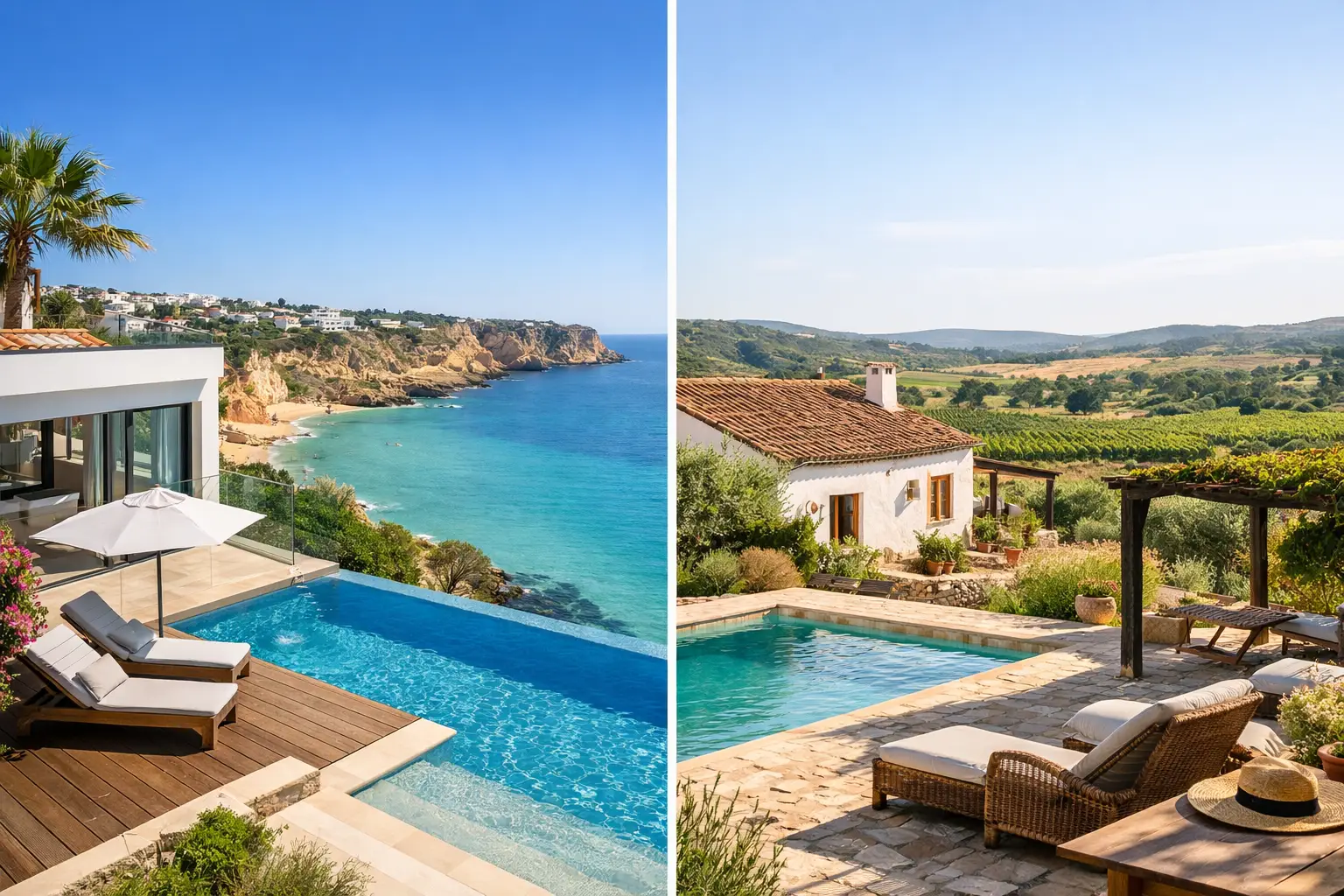
Algarve Coastal Versus Countryside Living

A sea view can make almost any property feel like the obvious choice. Until the first August traffic queue, the winter wind across an exposed terrace, or the realisation that the nearest useful supermarket is a 25-minute drive away. Algarve coastal versus countryside living is not simply a choice between beach and views. It is a decision about how you expect an ordinary Tuesday to work.
For overseas buyers, the distinction is often blurred by broad area labels and polished listing photographs. A home may be described as being near a coastal town while sitting well inland, or sold as peaceful countryside despite having a busy road, holiday rental neighbour, or challenging access. The right setting depends less on what looks most appealing online and more on how you will use the property through every season.
Algarve coastal versus countryside living: the real trade-off
The coast generally offers convenience, social life and easier day-to-day orientation. Established towns and resort areas put beaches, cafés, restaurants, medical facilities, shops and services within easier reach. For a first Algarve home, that familiarity can reduce friction considerably, especially when you are still learning the region.
Countryside living usually delivers more space, privacy and a stronger sense of separation from the holiday economy. You may find larger plots, fewer immediate neighbours and properties with character that would be difficult to afford near the sea. But rural does not automatically mean calm, and it rarely means simple. A pretty lane, a hillside position or a traditional farmhouse can bring practical compromises that matter far more once ownership begins.
The useful question is not, “Do I prefer the coast or the country?” It is, “What level of access, maintenance and isolation am I genuinely comfortable with?”
Coastal living: convenience comes with intensity
Coastal locations vary widely. A year-round town with a working centre feels very different from a resort-led development, a clifftop village or an urban beachfront neighbourhood. Yet the central advantage is consistent: daily essentials tend to be closer, and the area is usually easier for visiting family, older relatives and guests to navigate.
What works well near the coast
For buyers who plan to spend long periods in the Algarve, proximity can make a meaningful difference. Being able to walk to a coffee, pick up groceries without planning a car journey, or reach a beach on a winter afternoon makes a property easier to use. Families may value shorter school runs and simpler access to activities. Retirees often find that practical convenience becomes more valuable over time than an extra bedroom or larger garden.
Coastal homes can also be easier to share with guests. Visitors understand beach towns intuitively and often prefer not to depend on a host for every journey. This may matter if the property will be used by extended family or let on a permitted basis, although rental appeal should never be the only lens for choosing an area you hope to enjoy yourself.
The compromises buyers underestimate
The coast has an operating rhythm. In summer, parking, road access, restaurant availability and beach traffic can change sharply. A flat that feels perfectly placed in February may be surrounded by late-night footfall in August. A villa on the edge of a popular town may have a shortcut to the beach that becomes a steady stream of passers-by during peak weeks.
Winter deserves equal attention. Some locations remain lively, while others become noticeably quieter as seasonal businesses close and part-time owners leave. Neither is inherently better. The issue is whether the winter version of the area matches your expectations. If you want a sociable, walkable base through the year, verify what is actually open and how the streets feel outside school holidays.
Exposure is another overlooked factor. Sea air is attractive, but salt, wind and humidity can affect exterior finishes, metalwork, shutters, terraces and pool equipment. This is not a reason to avoid the coast. It is a reason to inspect the property’s condition and ongoing upkeep with clear eyes, rather than treating a sea-facing position as an uncomplicated premium.
Countryside living: space has a logistical cost
Inland homes often appeal to buyers who want a slower pace, a larger plot, mature planting, views and meaningful privacy. The countryside can offer an Algarve that feels less performative and more connected to local seasonal life. A village market, a reliable local restaurant and a familiar route through the hills can be deeply rewarding for people who want to settle rather than simply holiday.
But the countryside is not one thing. A property five minutes outside a town is operationally different from one reached by narrow lanes 25 minutes from the nearest major services. Elevation, road quality, neighbouring land use and distance from the main routes can matter more than the number of kilometres shown on a map.
Access is not a minor detail
Before choosing a rural property, consider the drive in both directions, not merely the distance. Is the final approach steep, narrow or unlit? Can two cars pass? What happens in heavy rain? Is there room to turn, park and receive deliveries without difficulty? A route that feels charming on a dry daytime viewing can feel very different after dark or when you are arriving tired from the airport.
This is particularly relevant for households with young children, older visitors or frequent guests. It also shapes the practicality of maintenance, building works and regular services. Larger rural homes typically ask more of their owners, even when they are in good condition. Gardens, pools, gates, drainage, water systems and outbuildings all need attention. The question is whether you welcome that involvement or would rather pay for less space and have fewer moving parts.
Privacy can be more complicated than it looks
A country setting may have no house immediately next door, yet still lack real privacy. Check sightlines from neighbouring land, passing traffic on rural roads, nearby agricultural activity and the location of walking routes. In parts of the Algarve, seasonal farming noise, dogs, cockerels and machinery are part of normal rural life. They are not defects, but they can be a poor fit for a buyer expecting complete silence.
Equally, a detached home in a secluded position may be wonderfully peaceful for some owners and isolating for others. If you are relocating full time, think honestly about your need for spontaneous social contact, classes, exercise, cafés and a community beyond your own plot. The answer can change after the novelty of a large terrace and open view wears off.
How your intended use should shape the choice
A second-home buyer who visits for school holidays has different needs from a couple relocating permanently. The former may accept summer activity because it is part of the experience, while the latter may care more about winter services and reliable local routines.
Families often benefit from a compromise location: close enough to a proper town for schools, sport, shopping and social life, but outside the busiest core. A property that saves ten minutes on the school run can improve family life more than a distant panoramic view.
For retirees, the key consideration is often future convenience. Stairs, parking, steep approaches and long drives may be manageable now but less attractive later. Being close to useful amenities is not a concession if it allows you to enjoy the property for longer.
For buyers focused on privacy and a more independent lifestyle, countryside living can be the better match, provided they are comfortable with driving and the property has dependable access. The strongest rural choices often sit within sensible reach of a year-round town rather than at the far end of an untested lane.
Evaluate the micro-location, not the postcode
The most expensive mistake is choosing an area category instead of a specific setting. Two properties in the same village can offer completely different lived experiences. One may have easy road access, sun, parking and a useful local centre nearby. Another may be shaded in winter, overlooked from a higher plot and affected by a road that is quiet only during the viewing.
When assessing either coast or countryside, look at the practical evidence: arrival routes, parking at different times, walking distances, surrounding plots, road noise, neighbour activity, mobile signal, winter sun and the journey to the places you will use weekly. Ask what the area is like in August, in January and on a wet weekday evening.
This is where independent local context matters. Property photographs show the building at its best angle. They rarely show whether the road backs up in summer, whether the nearest village is active year-round, or whether a supposedly tranquil plot sits beside land likely to generate noise and movement.
Choose the life you will actually lead
Coastal living suits buyers who value easy access, walkability, guest practicality and the energy of being close to the sea, accepting that popular locations can be busier, noisier and more exposed. Countryside living suits those who place more value on space, privacy and a slower rhythm, accepting greater reliance on a car and more responsibility for the property itself.
The best decision is usually more specific than either label. Find the setting that supports your normal routines, not just the version of Algarve life you picture on arrival. A home should still feel right when the beach is too windy, friends are visiting, the shops are busy and you need to get somewhere without turning the day into a journey.