
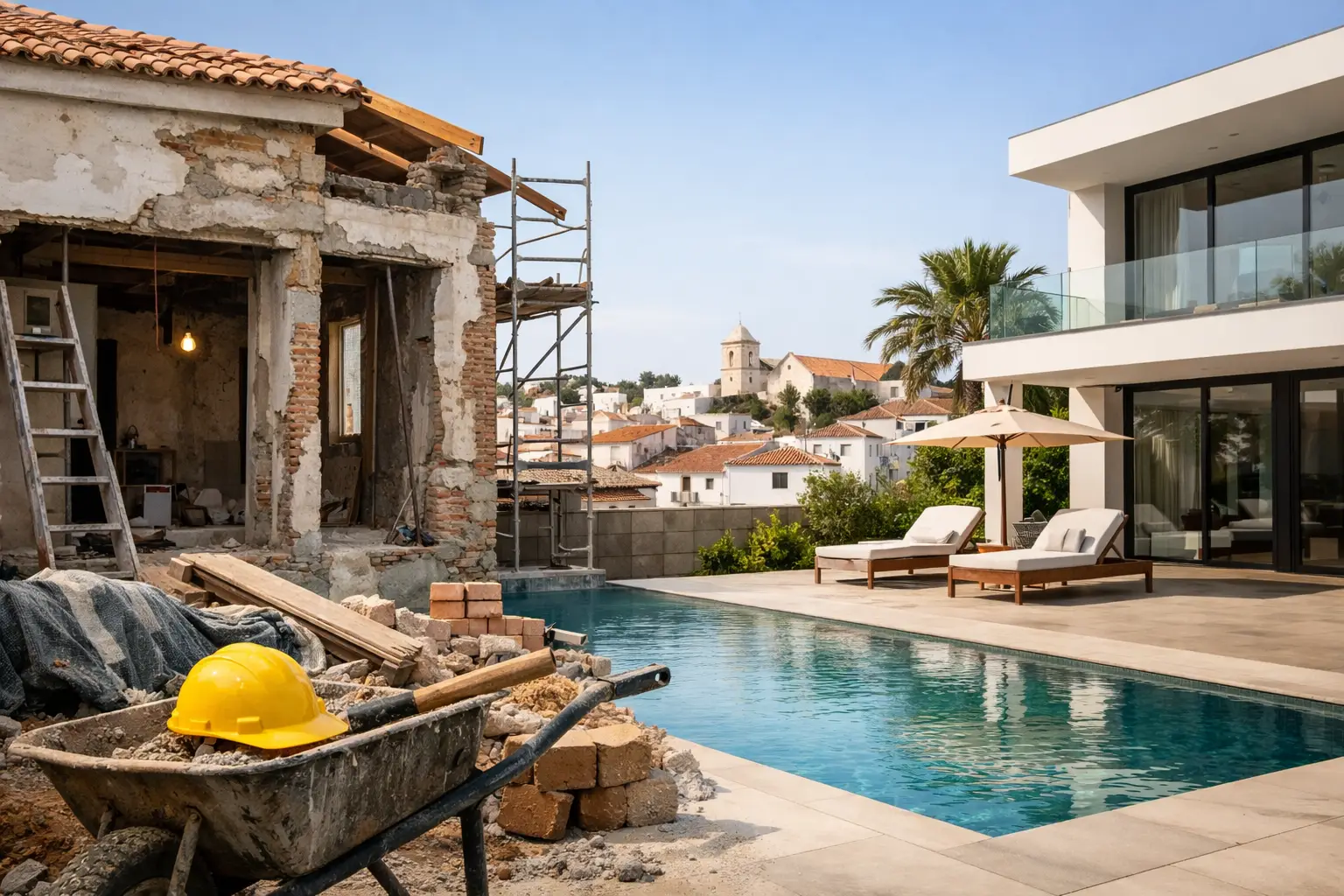
Renovation Risks When Buying Algarve Property

A whitewashed cottage with a roof terrace can look like a straightforward project from abroad. Then you arrive in January, find rain pushing through an old wall, a lane too narrow for deliveries, and a neighbour whose access crosses the plot. The renovation risks when buying Algarve property are rarely limited to the visible condition of the house. They are about what can realistically be changed, how work will happen, and whether the finished home will suit the life you came here to create.
Agent photos show the property. They do not show where a skip would sit, how far materials must be carried, whether the street becomes gridlocked in August, or how the area feels once the summer shutters close. For an overseas buyer, those details can turn a promising renovation into an expensive, slow and exhausting commitment.
Why the renovation budget is not the main risk
Most buyers expect renovation to cost more than the first estimate. The greater danger is buying a property whose limitations make the desired result impossible, impractical or poor value for that location.
A village house may have charm but no convenient vehicle access. A rural plot may feel private yet rely on a steep track that becomes difficult after heavy rain. A top-floor flat may have sea views but restricted space for scaffolding, deliveries and waste removal. These are not cosmetic inconveniences. They shape labour time, material costs, neighbour relations and the appetite of contractors to take on the job.
The scope matters too. Repainting, replacing kitchens and improving bathrooms are one category of work. Altering layouts, adding openings, raising roofs, changing façades or extending a building are another. Do not let a listing description that says “renovation opportunity” blur that distinction. Ask yourself what you need the property to become, then test whether the building and its setting can support it.
Renovation risks when buying Algarve property: permissions and restrictions
Older properties often invite imaginative plans: open-plan living, larger windows, a roof terrace, an extra bedroom, a pool or an annex for guests. Some may be achievable. Some may face restrictions that are not obvious from the road or the photos.
Historic centres, coastal areas, protected land, condominium buildings and properties with established boundaries can each bring constraints. Even where a visible neighbouring house has a certain feature, that does not mean the same change will be approved or appropriate for yours. Past alterations may not provide a reliable precedent.
Before you become emotionally attached to a layout, separate your must-haves from your preferences. If natural light, step-free access, an additional bedroom or outdoor dining space is essential, treat it as a decision point rather than a future design wish. A property that only works after several uncertain changes is a higher-risk purchase than one that works well from day one.
This is also where buyers can misread “potential”. Potential is not a room count on a floor plan. It is the combination of permitted work, available access, construction complexity and the money you are willing to spend in that specific micro-area.
Access determines more than most buyers expect
The Algarve has many older streets designed for pedestrians, donkeys and compact local traffic, not modern building logistics. That can be part of their appeal. It can also make renovation materially harder.
Visit at the times that matter. Is there space to stop without blocking a neighbour? Can a lorry approach the property, or will supplies need to be transferred from a distance? Is the route steep, sharply turning or busy with holiday traffic? Where will contractors park in high season? A house might be only a few minutes’ walk from a car park, but that walk can become a daily problem during months of work.
Access also affects your finished lifestyle. If you plan to spend long periods there, think beyond the construction phase. Carrying shopping uphill, receiving furniture, managing mobility in later life and hosting family are all more relevant than a charming cobbled approach on a sunny viewing day.
For flats and townhouses, shared areas deserve equal attention. Narrow staircases, small lifts, common courtyards and rules around working hours can change the practical scope of a project. The internal flat may be yours, but the route to it is often shared.
Moisture, heat and winter reality
Many buyers see the Algarve in its best light: dry air, bright skies and open windows. A property that feels cool and characterful in July may feel chilly, damp or under-ventilated in winter.
Older homes can have thick walls, original floors and attractive details, but they may also have limited insulation, ageing roofs, poor drainage or moisture trapped behind unsuitable finishes. Fresh paint can temporarily conceal staining. A dehumidifier in a corner can be a clue, not a solution.
Look carefully at the relationship between the building and its surroundings. Does rain run towards the house? Is the ground level outside higher than the internal floor? Are there shaded walls that receive little sun? Does the property sit below a road, against a slope or beside irrigated land? Each condition can affect how a house performs through the wetter months.
Heat deserves the same attention. Large south- and west-facing glazed areas can create spectacular views and punishing afternoon temperatures. Cooling, shading, ventilation and the orientation of outdoor space should form part of the renovation brief early, not become expensive afterthoughts.
The contractor question is really a timing question
Good local trades are busy. The project that looks modest to a buyer can be difficult to schedule, particularly if it involves specialist work, limited access or a property far from the main towns. Availability can shift, and timelines often depend on several trades working in sequence rather than one team arriving and finishing everything.
Buyers should assume that managing a renovation remotely requires more structure than managing a furnished purchase. Decisions will arise while you are abroad: a hidden problem behind a wall, a delayed delivery, a finish that is unavailable, or a change needed to accommodate an existing condition. If every decision requires a transatlantic call and a new instruction, delay becomes part of the cost.
It helps to be honest about your tolerance for ambiguity. Some buyers enjoy shaping an old house over time and can visit frequently. Others want to use the property within a defined period, perhaps before a school move, retirement date or first holiday season. Neither approach is wrong. But a house that needs extensive work is a poor fit for a fixed deadline unless the practical pathway is unusually clear.
Do not renovate past the location
A beautifully finished home cannot alter a poor approach road, an overlooked terrace, seasonal noise or an isolated setting that does not suit your daily needs. Nor can expensive finishes guarantee that the property will appeal to future buyers or guests in the way you expect.
This is particularly relevant for homes bought partly as an investment. The features that photographs reward are not always the features occupants value. Reliable parking, easy luggage access, a workable kitchen, outdoor shade, quiet bedrooms and proximity to year-round services may matter more than a dramatic but awkward design detail.
Equally, do not underinvest where the location genuinely supports a higher standard. The question is not whether renovation adds value in the abstract. It is whether the finished specification matches the street, neighbourhood, access and likely use of that particular home.
Assess the property as a working project
Before committing, view the home with two separate questions in mind. First: could we live here happily if little changed? Second: what exactly must change for it to work?
The gap between those answers is your exposure. A property needing only comfort upgrades gives you options. A property dependent on a new layout, extensive external work, complex access arrangements and a precise completion date gives you far less room for surprises.
When ARC assesses a specific property, the focus is not on selling the dream of a renovation. It is on the lived context around it: the lane, the parking, the slope, the seasonal rhythm, the neighbouring homes and the practical friction that a listing cannot show.
A good Algarve renovation should leave you with more than attractive photographs. It should give you a home that is comfortable in winter, workable on an ordinary Tuesday, and still worth choosing after the builders have gone.